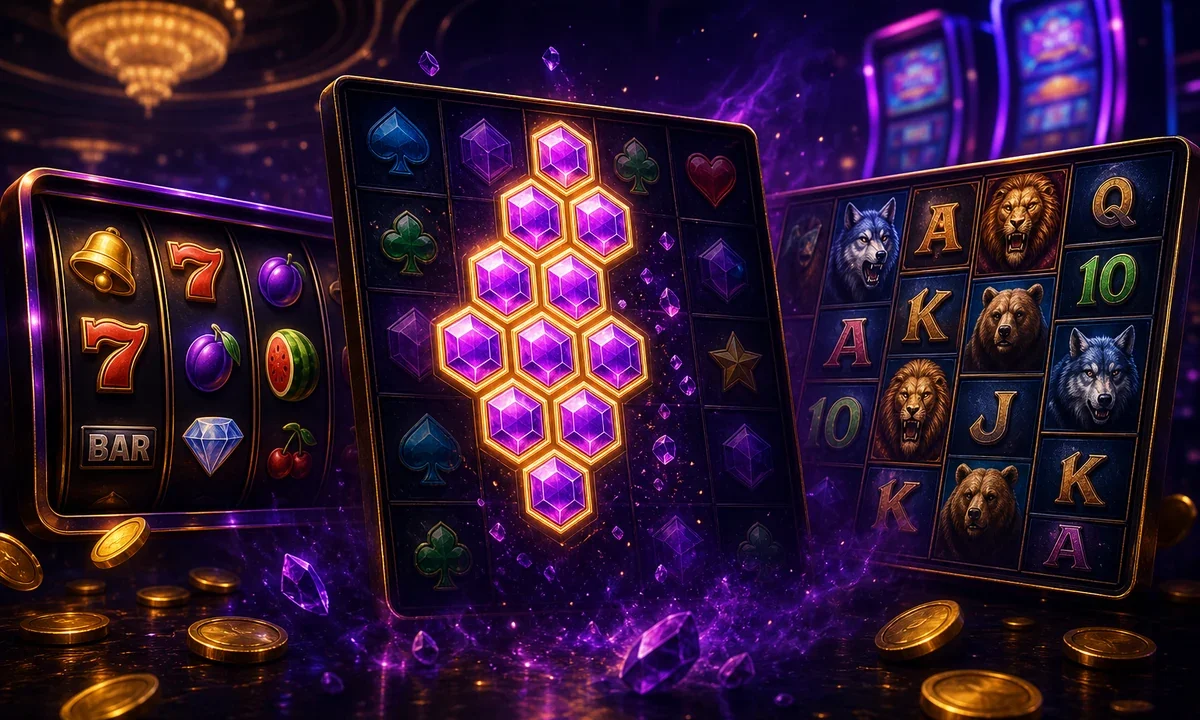
Every slot you open at an AGCO-licensed Ontario casino is built on one of three fundamental reel engines: fixed paylines, Megaways, or Cluster Pays. The math behind each is genuinely different, not just cosmetically. Understanding how each engine calculates a win tells you a lot about why a game feels the way it does, where the volatility comes from, and which format suits how you actually want to play.
Paylines: The Original Engine, Still Everywhere for Good Reason
A fixed payline slot pays out when matching symbols land on a pre-defined path across the reels, typically left-to-right starting from reel one. The number of active lines can range from a single centre row on a classic three-reel fruit machine all the way to 243 or even 1,024 ways on a multi-reel grid, but the core logic stays the same. You win when the designated pattern lands. That’s it.
The predictability is the point. NetEnt built much of its legacy catalogue on fixed paylines, and games like Starburst (96.1% RTP, low-medium volatility) and Book of Dead from Play’n GO (96.21% RTP, high volatility) remain among the most-played slots in Ontario lobbies precisely because the win logic is transparent and the risk profile is clear before you spin. Dead or Alive 2, also from NetEnt, sits at 96.8% RTP with a verified 100,000x max win, an extreme ceiling for a payline game, delivered through three selectable free-spins modes rather than any mechanical complexity in the base engine.
The volatility of a payline game is almost entirely a function of how the math model is tuned, not the payline structure itself. You can have low-volatility payline slots that pay small amounts constantly, and high-volatility payline slots that run ice-cold for 60 spins before a feature fires. The engine doesn’t dictate the variance, the RNG math does.
Where paylines genuinely limit a game is ceiling potential. With fixed win paths and a static reel structure, there’s an upper bound on how many simultaneous wins can stack in a single spin. That’s why developers pushing max-win ceilings above 50,000x almost always reach for a different engine.
Megaways: Variable Reels and the Mathematics of Unpredictability
Big Time Gaming invented the Megaways mechanic, and what they built is genuinely clever. On every spin, each reel randomly generates between two and seven symbol positions. With six reels operating independently, the total number of active ways to win shifts on every single spin, reaching a theoretical maximum of 117,649 ways. For players used to 20 fixed lines, that number changes how the game feels in real time.
Big Time Gaming’s Bonanza Megaways, the original Megaways title, carries a 96.0% RTP, high volatility, and a 26,000x theoretical max win. The cascade mechanic paired with an escalating multiplier in the bonus round is what makes it genuinely compelling rather than just mechanically novel.
Wins in Megaways are calculated by matching symbols on adjacent reels left-to-right, not on fixed lines, but in any position on the active reel. When you have seven symbols on reel one and seven on reel two, every one of those first-reel symbols can potentially combine with every one of the second-reel symbols. That’s the source of Megaways’ ceiling: sheer combinatorial volume. The cascade mechanic, which removes winning symbols and drops new ones in their place within the same spin, compounds this further.
The licensed Megaways engine is now deployed by dozens of studios. Pragmatic Play‘s Anime Mecha Megaways carries a 96.09% RTP, high volatility, and a 40,000x max win driven by the Tumble Feature, by far the highest ceiling in Pragmatic Play’s catalogue. Blueprint Gaming, Red Tiger, and NetEnt have all built licensed Megaways titles. The format has become, as covered in our detailed Megaways licensing piece, an infrastructure layer for the entire industry.
Volatility in Megaways titles tends to sit at high-to-extreme. The variable reel height means many spins produce few or no wins, when you get four symbols on each reel instead of seven, your win-way count collapses. The payback is heavily concentrated in cascade sequences and bonus rounds where the multiplier climbs. That is the mechanical reason Megaways titles run cold in the base game. It’s not a flaw. It’s the architecture.
Cluster Pays: Adjacency Over Alignment
Cluster Pays throws the payline concept out entirely. Instead of matching symbols on fixed paths across reels, you need a minimum cluster of identical symbols that are adjacent to each other, horizontally and vertically, anywhere on the grid. Most cluster titles play on a 7×7 or 8×8 grid rather than a traditional reel layout. A cluster of five or more matching symbols pays out, the winning symbols then disappear and new symbols fall from above, potentially creating chain reactions in a single round.
Play’n GO’s Reactoonz is the clearest example in the current Ontario market, 96.2% RTP, high volatility, 10,000x max win. The game’s Quantum Features fire when specific symbol counts are hit during a cascade chain: multipliers attach to symbols, random transformations trigger, and the Gargantoon wild can fill a 3×3 block. The 10,000x ceiling is built through stacked feature states, not a single lucky spin. There’s no traditional bonus round to trigger. The entire game is the bonus round.
That one structural difference changes everything about how you manage a session.
NoLimit City takes the cluster-adjacent concept further still with its proprietary xWays mechanic, symbols that expand on landing to reveal two to four symbols simultaneously, multiplying win potential beyond what a fixed grid can produce. Infectious 5 xWays (96.02% RTP, high volatility, 55,555x max win) is the most technically demonstrative example: the xWays symbols don’t just expand the grid, they compound across every adjacent cluster evaluation in that spin.
Which Engine Produces Which Kind of Win?
The honest answer is that any engine can be tuned to any volatility level, but each format has a natural gravity. Payline slots are most commonly built around predictable base-game hit frequencies with a clear feature trigger moment. Megaways titles front-load variance into base-game dry spells and concentrate payback in bonus rounds. Cluster pays games create rolling, in-spin cascade chains that feel different from either, wins build within the spin rather than being awarded at the end of a static reel stop.
For max-win chasers, Megaways and cluster mechanics offer higher theoretical ceilings than most payline games, purely because their win-calculation frameworks allow more simultaneous combinations. For players who want regular small wins and clear session structure, a well-tuned payline game at medium volatility will serve better. For players who enjoy reading the game’s own logic, watching cascade chains build, tracking feature states, cluster mechanics reward active attention in a way fixed-line slots rarely do.
The Megaways engine reaches a maximum of 117,649 ways to win on a six-reel layout when every reel shows its full seven symbols, a combinatorial scale that no fixed payline structure can match, and the mathematical reason the format produces the outsized max-win ceilings it does.
Provider identity often tracks engine preference. Big Time Gaming invented Megaways and remains its most architecturally committed practitioner. Play’n GO has built a cluster catalogue around the Reactoonz series. NoLimit City’s proprietary xSlot mechanics sit in a category of their own, neither traditional paylines nor licensed Megaways, but a bespoke engine designed for extreme-volatility outcomes. For a full breakdown of how individual providers use these engines across their catalogues, the Pragmatic Play vs Play’n GO comparison covers catalogue-level differences in depth.
Does the Engine Affect RTP?
Not directly. RTP is set by the game’s math model and certified by the regulator, regardless of which engine delivers the wins. A Megaways title can be certified at 96.71% (Fruit Shop Megaways by NetEnt) or at 96.0% (Bonanza Megaways). A payline game can sit at 98.04% (Pragmatic Play’s Angel vs Sinner Eternal Battle) or as low as the operator-configured floor for any given jurisdiction. The AGCO in Ontario requires that operators disclose the configured RTP in each game’s help screen, so regardless of which engine you’re spinning, the actual return figure is accessible before you commit real stakes.
What the engine does affect is how that RTP is distributed across a session. Megaways and cluster games tend to concentrate returns into fewer, larger events. Payline games, particularly medium-volatility titles, distribute more evenly across spins. Same percentage returned over millions of spins, very different experience in a two-hour session.
Key Takeaways
Paylines offer transparent win logic and stable session structure, Megaways delivers combinatorial volume and variance-concentrated bonus rounds, Cluster Pays replaces reel alignment with cascading adjacency chains that build wins within the spin itself. None of the three is objectively superior, but knowing which engine you’re loading before you open a game is the most practical piece of slot literacy any informed player can have.
Sources
- SlotVault.io, Megaways Licensing in 2026: How Big Time Gaming’s Engine Became iGaming’s Most-Licensed Mechanic | https://slotvault.io/megaways-licensing-in-2026-how-big-time-gaming-s-engine-became-igaming-s-most-li/
- SlotVault.io, Best High Volatility Slots at Ontario Online Casinos (2026): Big Risk, Bigger Reward | https://slotvault.io/best-high-volatility-slots-ontario/
- SlotVault.io, Top 10 Play’n GO Slots at Canadian Online Casinos (2026), Reactoonz mechanic and RTP data cited | https://slotvault.io/top-10-playn-go-slots-canadian-online-casinos/
- Big Time Gaming, Bonanza Megaways game specification (RTP, max win, volatility) | https://www.bigtimegaming.com