The iGaming supply chain used to look a lot like indie rock, with hundreds of small, fiercely independent studios competing on creativity, each with a distinct sound. That picture is changing fast. Over the last five years, a handful of large companies, most notably Evolution, have been buying slot studios with the same appetite that streaming platforms once bought record labels. For players in Ontario and across North America, this consolidation trend is not just a business story. It touches the games on your screen, the mechanics in your feature rounds, and potentially the RTP figures sitting in every help menu.
How Did We Get Here? The Acquisition Playbook
Evolution is the clearest case study. The company built its dominance in live dealer casino, Lightning Roulette, Crazy Time, Infinite Blackjack, and then turned that cash flow into a systematic acquisition programme targeting slot studios. The strategy followed a recognisable logic: why build RNG slot capability from scratch when you can buy studios that already have it, along with their catalogues, their tech, and their operator relationships?
Evolution’s acquisition of NetEnt in 2020 was the move that announced the new era. NetEnt had spent two decades building one of the most respected slot catalogues in the industry. Dead or Alive 2 carries a 96.8% RTP, high volatility, and a verified 100,000x max win, a benchmark for extreme-variance play that still holds up in 2026. The NetEnt deal also brought Red Tiger along with it, a studio that had built a reputation for daily jackpot mechanics and high-frequency feature triggers. Then came the acquisition of NoLimit City in 2022, a studio that had distinguished itself specifically through mechanical aggression, xNudge, xWays, xBomb, features designed to push volatility into territory most developers would not touch. Evolution now owns the studio responsible for titles like Mental (66,666x max win, extreme volatility, 96.06% RTP) alongside the live dealer infrastructure that powers virtually every Ontario operator’s table game lobby.
On a different trajectory sits Pragmatic Play, which took the organic growth route rather than the acquisition route, building out its own slot catalogue to become the most widely distributed studio in Ontario’s regulated market while simultaneously developing its own live casino vertical. The result is a provider that now competes in multiple verticals under one roof, with slots like Gates of Olympus 1000 (96.5% RTP, high volatility, 100,000x max win) sitting alongside its live dealer offering. The underlying consolidation logic is the same regardless of approach. Both strategies are about owning more of the value chain.
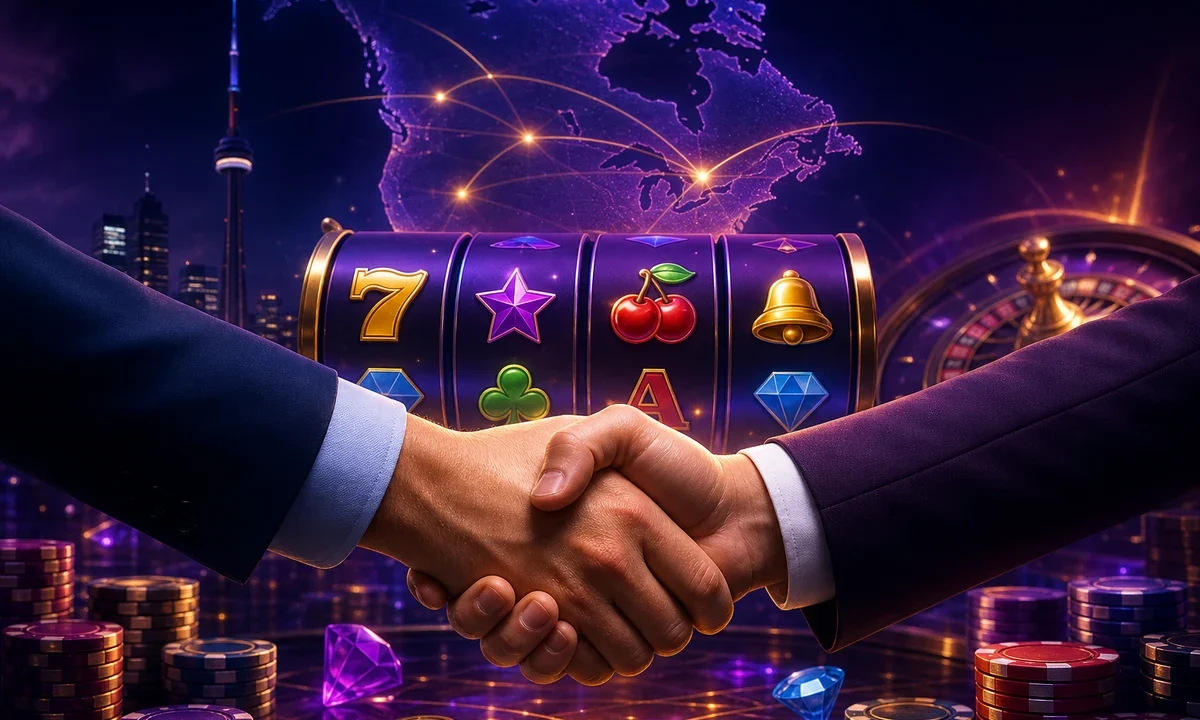
Most recently, Toronto-based Bragg Gaming Group announced the acquisition of Drayton International in 2026, adding five game development studios, Boomerang Studios, Dream Streak Gaming, Rise Gaming, Hit Squad, and Neotopia, plus three technology and distribution platforms and a portfolio of over 100 casino titles in a single deal, as reported at the time of the announcement. Bragg’s Q1 2026 results, released alongside the news, showed a 33.3% year-over-year revenue increase in Brazil. The Drayton deal signals that mid-tier aggregators are playing the same consolidation game as the major players, just at a different price point.
Does Consolidation Kill Game Diversity?
This is the question that matters most to players, and the honest answer is that it depends on how the acquiring company operates the studios it buys.
The optimistic scenario, which Evolution has largely delivered so far, is that acquired studios keep their creative identity. NoLimit City still operates with evident independence. Its release cadence, mechanical philosophy, and brand voice have not been homogenised into something that resembles an Evolution live dealer product. NetEnt continues to release titles under its own brand, and Red Tiger maintains its own identity at the operator level. From a player-facing standpoint, you are still choosing between meaningfully different studios when you navigate a casino lobby.
The structural concern runs deeper. When a single parent company controls five, six, or seven slot studios, content exclusivity deals become more powerful tools for locking in operator relationships. If Evolution can bundle live dealer, NetEnt slots, NoLimit City titles, and Red Tiger games into one operator contract, smaller independent studios face a tougher negotiation environment. An operator signing a comprehensive Evolution content deal has less catalogue space, and less commercial incentive, to feature games from genuinely independent studios like Push Gaming or Thunderkick. That is where diversity genuinely erodes. Not in the studios themselves, but in their access to distribution.
What we are already seeing in Ontario’s AGCO-licensed market is instructive. The operators with the deepest catalogues, those pulling from 40-plus providers, tend to offer the most mechanically varied libraries. As our analysis of Ontario casino libraries has found, a casino stocking titles across NoLimit City’s extreme-volatility catalogue, Big Time Gaming’s Megaways architecture, and Hacksaw Gaming‘s Hold & Win mechanics is a fundamentally different environment from one built around a single consolidated provider’s output. Consolidation at the top of the supply chain makes provider breadth at the operator level more important, not less.
What Happens to RTP When Studios Get Acquired?
Acquisition does not automatically change a game’s certified RTP. Dead or Alive 2’s 96.8% RTP did not shift when Evolution absorbed NetEnt. A game’s certified mathematics are fixed at the point of independent testing laboratory sign-off, eCOGRA, GLI, BMM Testlabs, and rewriting them requires a fresh certification process. Publisher-stated RTPs travel with the game.
The more consequential layer is operator-configured RTP. Most modern slots are built with a configurable range: a studio might certify a game at 94%, 96%, and 97%, and operators choose which version to deploy. In Ontario’s regulated market, the AGCO requires that games meet minimum RTP standards and that software be certified, which provides a meaningful floor. Within that permitted range, however, variation is real. When a large conglomerate owns both the studio producing a game and has preferred-partner relationships with the operators distributing it, the incentive structure around which RTP configuration gets deployed becomes more opaque. The same title can return different percentages at different casinos, which is why checking the configured RTP in a game’s help screen matters more than trusting the publisher’s headline figure.
Ontario’s regulated framework is the strongest protection players currently have against this kind of quiet compression. The AGCO and iGaming Ontario certification requirements set a floor that unregulated offshore alternatives simply do not match. Alberta’s regulated iGaming market launches July 13, 2026 through the AGLC framework, and will inherit the same structural protections, a genuine advantage for players in that province moving from offshore platforms to licensed operators.
Does Scale Produce Better Games?
There is a legitimate case that consolidation produces better games, not just more efficiently distributed ones. When Evolution acquires NoLimit City, it brings distribution infrastructure, compliance resources, and technology investment that a smaller independent studio might struggle to fund alone. The xSlot mechanics that NoLimit City has been developing, engineered partly with North American regulatory requirements in mind, as reported in our coverage of their US market ambitions, require significant R&D investment that a well-capitalised parent can sustain over years rather than funding cycle to funding cycle.
The counterargument is that the creative risk-taking that produced those mechanics happened precisely because NoLimit City was a scrappy independent studio competing on innovation rather than scale. The same story applies to Big Time Gaming, whose decision to license the Megaways engine rather than hoard it reshaped the entire industry. Bonanza Megaways, the title that proved the concept, carries a 96.0% RTP, high volatility, and a 26,000x max win, and it was built by an independent studio with nothing to lose by being contrarian. Whether the next Megaways-level mechanic comes from inside a conglomerate or from a genuinely independent outfit like Hacksaw Gaming is an open question, but disruption tends to originate outside established walls.
What Should Players Watch For?
The most useful signal of whether an acquisition preserves studio independence is creative output in the 12 to 24 months after the deal closes, not press releases issued on announcement day. Watch the release cadence and mechanical originality. If a studio that built its name on pushing volatility boundaries starts shipping conservative titles optimised for mass-market operator placement, the independence was nominal.
Checking game help screens before any significant session remains the most direct protection available. The configured RTP at your specific casino is the only figure that affects your actual return, and in a market where a single company might own the game, the distribution platform, and hold a preferred-partner agreement with the operator, that verification carries more weight than it did five years ago.
The consolidation trend is not reversing. The economics that drove Evolution to spend billions acquiring NetEnt, Red Tiger, and NoLimit City are the same economics pushing Bragg Gaming toward the Drayton deal, scale, distribution leverage, and the desire to own more of the value chain. What changes is how informed players are when they navigate the result. The provider landscape you see in your casino lobby in 2026 is increasingly the product of M&A decisions made in boardrooms rather than creative decisions made in development studios, and knowing the difference is the starting point for playing it well.
Key Takeaways
iGaming’s consolidation wave, led by Evolution’s acquisitions of NetEnt, Red Tiger, and NoLimit City, and extended by deals like Bragg Gaming’s Drayton purchase in 2026, is reshaping which studios reach players and on what terms. Regulated markets like Ontario’s AGCO framework provide the strongest available safeguard against RTP compression, but the floor only protects you if you are playing on a licensed platform. Watch post-acquisition creative output, verify configured RTP in game help screens, and favour operators with genuine provider breadth rather than deep libraries built around a single consolidated supplier.
Sources
- Bragg Gaming Group, Q1 2026 Results & Drayton International Acquisition Announcement, Casino.org (May 2026)
- Gambling Insider, “Timeline: All of Evolution’s Biggest Acquisitions” (July 19, 2024) | https://www.gamblinginsider.com/news/24006/timeline-all-of-evolutions-biggest-acquisitions
- SlotVault.io, “Megaways Licensing in 2026: How Big Time Gaming’s Engine Became iGaming’s Most-Licensed Mechanic” | https://slotvault.io/megaways-licensing-in-2026-how-big-time-gaming-s-engine-became-igaming-s-most-licensed-mechanic/
- iGaming Ontario Public Operator Registry (verified June 2026) | https://www.igamingontario.ca/en/operator
- SlotVault.io, “NoLimit City Eyes the US Market: What xSlot Mechanics Mean for American Regulation” | https://slotvault.io/nolimit-city-eyes-the-us-market-what-xslot-mechanics-mean-for-american-regulation/